
Applications of Polyethylene in Blow Molding
Versatile Polymers for Blow Molding
The blow molding process is quite simple. The polymer is first melted and then blown through the mold to take the desired shape. Blow molding processes are based on versatile polymers, which have a variety of properties that are required to create a wide range of goods. Polymers’ remarkable flexibility allows producers to mold them into various forms and sizes to suit a wide range of industrial uses. They can be configured to work with a range of industrial processes.
One polymer that stands out among those commonly utilized in blow molding is high-density polyethylene (HDPE). HDPE is a popular choice in a variety of industries due to its high strength-to-density ratio and chemical resistance. Because of its unique molecular structure, it is extremely strong and durable, ensuring the integrity of blow-molded goods even in severe settings. Beyond its mechanical properties, HDPE is highly recyclable, making it suitable for modern environmental programs. Its cost-effectiveness and widespread availability lead to its dominance in the blow molding market.
Importance of Material Selection
Like with any other process, the first step in blow molding is to select appropriate polymers for the end use. Once chosen, this material is thoroughly prepared, preparing it for the next steps. While a variety of polymers can be used in this procedure, most industry experts prefer to work with HDPE.
Polyethylene (HDPE) Blown Grades
Jam, Marun, Bandar Imam, Bakhtar Petrochemicals, and AryaSasol Polymer Companies are the largest producers of polyethylene (HDPE) blow molding grades in Iran, which are widely used in a variety of products.
Analysis of Polyethylene (HDPE) Blown Grade
The different blow molding grades of HDPE raw material are shown below. These HDPE grades will be exported with the HS code 39012040.
You can also download the catalogue by clicking this button.
Petro Nour Mehr company can export raw materials required for manufacturing various products in the industries above at the best costs and with the greatest quality.
Also, if you want to see the other polymer materials Petro Nour Mehr can supply and export, click on this link.
Applications of Blow Molding
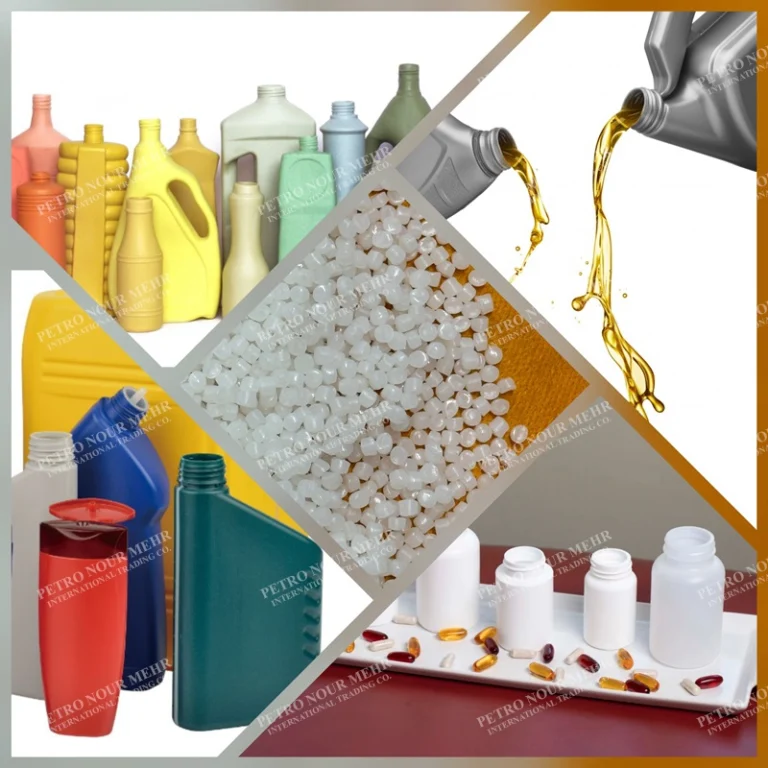
Blow molding is currently a very popular manufacturing technology that is used in practically all industries for specific components from containers and packaging of pharmaceuticals & surfactants to bottles for bleach, motor oils, toiletries, and jerrycans.
Small Containers and Bottles
HDPE provides producers a flexible and economical way to make a wide range of containers, from small motor oil and water bottles to bigger jerrycans for storing chemicals like bleach.
Toiletry Bottles
Toiletry bottles, which hold hand soap and shampoo, must be manufactured of a material that is both attractive and durable. Because of HDPE’s versatility in terms of design and color selection, bottles that are both visually appealing and useful can be created, improving the user experience.
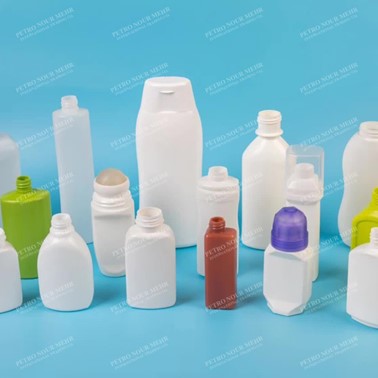
Using HDPE blow molding in producing toiletry bottles
Bleach Containers
Packaging for chemicals such as bleach must withstand their corrosive properties. HDPE is an excellent material for bleach containers because of its resistance to chemicals and ability to preserve structural integrity under challenging conditions.

Using HDPE blow molding in producing bleach containers
Motor Oil Bottles and Jerrycans
Because of its durability, HDPE is an ideal material for storing lubricants, motor oil, and other automotive fluids. Even in tough industrial environments, the durability of HDPE containers ensures the safety of these fluids throughout storage and transportation.

Using HDPE blow molding in producing motor oil bottles and jerrycans
Water Bottles
Water bottle manufacturers make significant use of HDPE blow molding. HDPE is an excellent material for packing potable water due to its low weight and strong resistance to moisture and chemicals. Bottles of various sizes and shapes can be manufactured using blow molding technology to meet a wide range of consumer preferences. HDPE water bottles are also recyclable, which aligns with growing environmental concerns.
Packaging of pharmaceuticals & surfactants
HDPE’s resistance to moisture and gasses keeps pharmaceutical items safe and undamaged, while also protecting them from outside pollutants and chemical reactions. Furthermore, because HDPE is recyclable, it supports recycling and reuse in packaging processes, which are consistent with environmental goals.

Using HDPE blow molding in pharmaceutical packaging
Berry Global Group, Inc. is one of the largest companies that manufacture a variety of plastic packaging products as well as different containers and bottles, which, in some cases, use the blow molding method.
It should be noted that Petro Nour Mehr Company can supply and export materials for any of those above and other applications.
Blow Molding Process
The method used to create hollow plastic pieces is called blow molding. After feeding the machine with the desired polymer, the process begins with the heating of a parison or preform to melt the polymer. A hole at one end of the parison, a plastic tube-like object, allows compressed air to pass through it. Next, air blows into the mold while the plastic workpiece is clamped into the mold. The plastic is inflated by the air pressure and takes on the shape of the mold.
Then, the mold opens and the part is released after the plastic has cooled and solidified. When the product has completely cooled, it is gently ejected from the blow molding machine. The final step is to remove any excess plastic, especially around the air injection site.
Blow molding frequently exhibits flashing. There are times when the product contains flash at the top and bottom, especially where the compressed air is injected. So, at the final stage, the excess material is removed with a revolving knife. To reduce waste, certain methods collect excess materials, grind them, and refeed them into the extruder machine.
Types of Blow Molding
In general, there are three main types of blow molding:
- extrusion blow molding:
Extruding the hollow preform is the essential step in this process. Compressed air gives the preform life once one end is sealed, causing it to change and conform to the mold’s dimensions. The product is cooled and ejected after it has been molded.
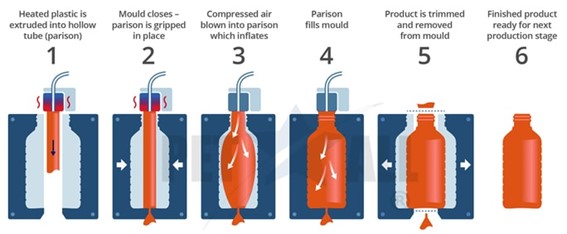
Schematic of extrusion blow molding process
- injection blow molding:
Injection molding and blow molding are combined in injection blow molding. First, the process involves creating the initial preform by injecting molten plastic onto a metal rod inside a mold. The preform then enters a second mold that replicates the shape of the finished product with the rod accompanying it. The preform becomes mirrored in the mold by injecting compressed air into it.
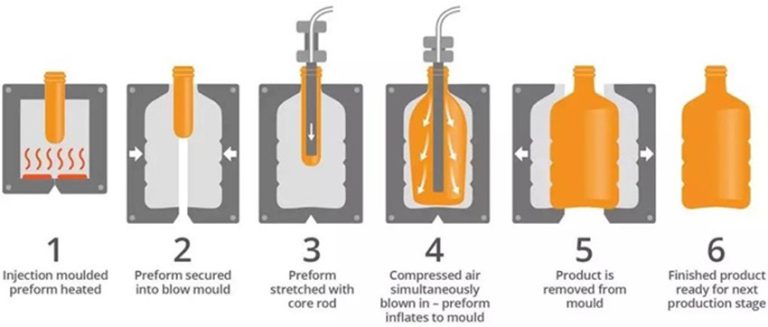
Schematic of injection blow molding process
- stretch blow molding:
Stretching is a new step in this process, sometimes considered a subset of injection blow molding. Following the fabrication of the preform, a rod stretches it to the specified dimensions, and inflation produces the finished product. Stretching increases the product’s mechanical resistance.
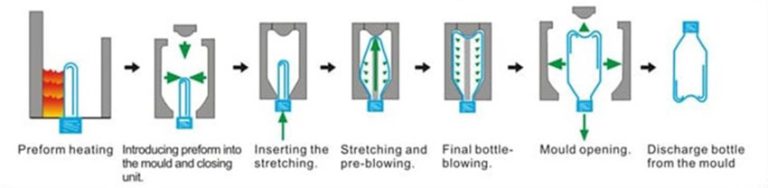
Schematic of stretch blow molding process
Advantages of Blow Molding
In comparison to other fabrication techniques, blow molding is typically less expensive, allowing for complete customization and scalability to meet the needs of you or your customers. Furthermore, it makes adding external threads easier, improving the overall consistency and quality of the result.
Also, blow molding is a fairly fast manufacturing option. Large amounts of completed plastic goods can be produced using professional quality injection or extrusion blow molding technology, which can operate for almost endless amounts of time.
As previously said, blow molding’s adaptability is a major benefit and the reason it transformed multiple industries. Food suppliers, pharmaceutical and medical industries, and other businesses find blow molding particularly appealing due to the wide range of customizable bottles, containers, and other items it offers.
Challenges in Blow Molding
Firstly, it should be noted that to operate an extrusion blow molding machine professionally, one must be trained. It is not as easy to use as other household appliances. The product with excess plastic after extrusion blow molding is known as “flash”. However, a modern extrusion blow molding machine includes an automated deflash device in addition to a recycling system. Furthermore, it is difficult to create complex component geometry with good dimensional accuracy, and also, thick parts cannot be manufactured.
Quality Control in Blow Molding
Throughout the blow molding process, raw material quality is critical. To ensure that incoming materials meet requirements, they must undergo stringent quality control inspections. This prevents finished items from having uneven thickness, poor transparency, or structural flaws.
Maintaining optimal operating conditions is critical for product quality and safety. Throughout the molding process, this includes monitoring and managing variables such as temperature, pressure, and cycle times. Variations from the suggested parameters may result in defective goods and endanger the machinery’s safety.
Additionally, as previously stated, the success of any blow molding process is dependent on having qualified and well-trained operators. Operators must understand the machinery’s unique characteristics, safety precautions, and troubleshooting methods.
Innovations in Blow Molding Technology
Precision controls for temperature, pressure, and speed are aspects of contemporary technology that ensure consistent quality while reducing waste and energy use. Mold design advancements, such as co-extrusion and multi-layer molding, have boosted customization options and enabled the creation of complicated geometries with varying wall thicknesses and integrated components. These innovations boost product adaptability in a wide range of industries.
In addition, blow molding innovations are driven by a commitment to sustainability, to reduce environmental impact through techniques like weight reduction and recycling optimization. Manufacturers include eco-friendly alternatives, such as recycled materials and biodegradable additives, in their production processes.
Furthermore, advancements in quality control and process monitoring enabled by sensors and real-time feedback systems ensure early problem detection and adjustment, minimizing scrap and production time.
Global Market Insights
The global blow molding market covers a variety of techniques, each with its own set of applications and advantages, including injection blow molding, stretch blow molding, and extrusion blow molding. Extrusion blow molding is commonly used to make large containers and hollow goods, whereas injection blow molding is better suited for accurately making small, complex objects. Stretch blow molding is used to mass-produce PET bottles for drinks.
Polyethylene, particularly HDPE, is the preferred material for blow molding due to its high mechanical properties, chemical resistance, and recyclable nature. Although HDPE remains popular due to its low cost and versatility, local customs and rules may influence the amount of material used. For example, the usage of recycled and biodegradable materials is becoming increasingly popular in countries with tight environmental requirements, potentially affecting the demand for traditional HDPE in blow molding applications.
- Purchase from a trustworthy provider with credentials to ensure quality.
- Compare the pricing of these materials in various markets with the global market price.
- Examine the sales conditions, including quantity, delivery time, packaging, transportation methods, and payment terms.
- Contact Petro Nour Mehr Company to acquire the best export price according to your requirements.
- Petro Nour Mehr Company provides secure and suitable payment methods based on consumer preferences.
- It’s notable that our company has contact with several reputable transportation providers which can assist you find the best solutions.
- Also, the company provides customers with the necessary documentation for customs clearance in their final city.